
Understanding the Tissue Healing Stages
Tissue healing stages describe the biological process your body follows after an injury. Whether you are recovering from a muscle strain, ligament sprain, tendon injury, or fracture, your body begins repairing damaged tissue almost immediately.
Recovery happens through overlapping phases of inflammation, repair, and remodeling. One important point is that feeling better does not always mean the tissue has completely healed.
Pain and swelling may decrease before strength, mobility, and tissue capacity have fully returned. This is why rehabilitation should consider function and physical demands, not only how much time has passed.
At Couve Health, our chiropractic and physiotherapy treatments help patients progress safely through the tissue healing stages while rebuilding movement, strength, and confidence.
What Are the 3 Tissue Healing Stages?
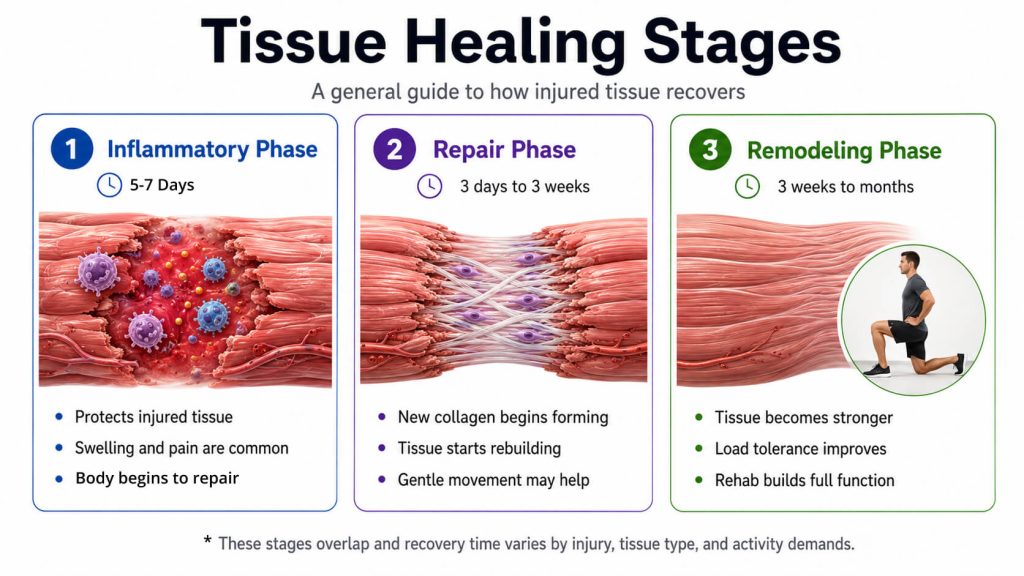
The tissue healing process is commonly divided into three overlapping phases:
- Inflammatory Phase: The body responds to injury and begins clearing damaged tissue.
- Repair Phase: New collagen and repair tissue begin forming.
- Remodeling Phase: The new tissue reorganizes and becomes better able to tolerate physical load.
These stages overlap and vary depending on the tissue involved, injury severity, general health, and the activity you are returning to.
Stage 1: The Inflammatory Phase
The first of the tissue healing stages begins immediately after injury. The body creates an inflammatory response that helps protect the area and starts clearing damaged cells.
Common symptoms may include:
- Pain or tenderness
- Swelling
- Warmth
- Stiffness
- Reduced movement
Early rehabilitation generally focuses on protecting the injured area, managing excessive symptoms, and maintaining safe movement where appropriate.
Stage 2: The Repair Phase
During the repair phase, the body begins producing new collagen and structural tissue around the injured area.
This new tissue is still immature, so rehabilitation is usually progressed gradually.
- New collagen begins forming
- Tissue starts rebuilding
- Gentle movement may help
The goal is to help the recovering tissue adapt without placing more stress on it than it can tolerate.
Stage 3: Remodeling and Maturation
The remodeling stage is often the longest part of recovery. Newly formed tissue continues reorganizing and becoming better able to tolerate movement and force.
Depending on the injury, rehabilitation may progress toward:
- Heavier resistance training
- Improved endurance
- Balance and coordination
- Running and jumping
- Sport or work specific exercises
This stage helps bridge the gap between feeling better and being physically prepared to return to normal activity.
How Long Do the Tissue Healing Stages Last?
There is no single recovery schedule that applies to every injury, but the general process can be understood as:
- First several days: Inflammation and protection are most prominent.
- Several days to several weeks: New repair tissue and collagen begin forming.
- Approximately 3 weeks onward: Remodeling and strengthening become increasingly important.
- Several months or longer: Tissue may continue adapting and maturing.
These are general biological phases, not guaranteed recovery dates. A mild muscle strain may recover much faster than a significant tendon, ligament, or bone injury.
How Different Tissues Heal
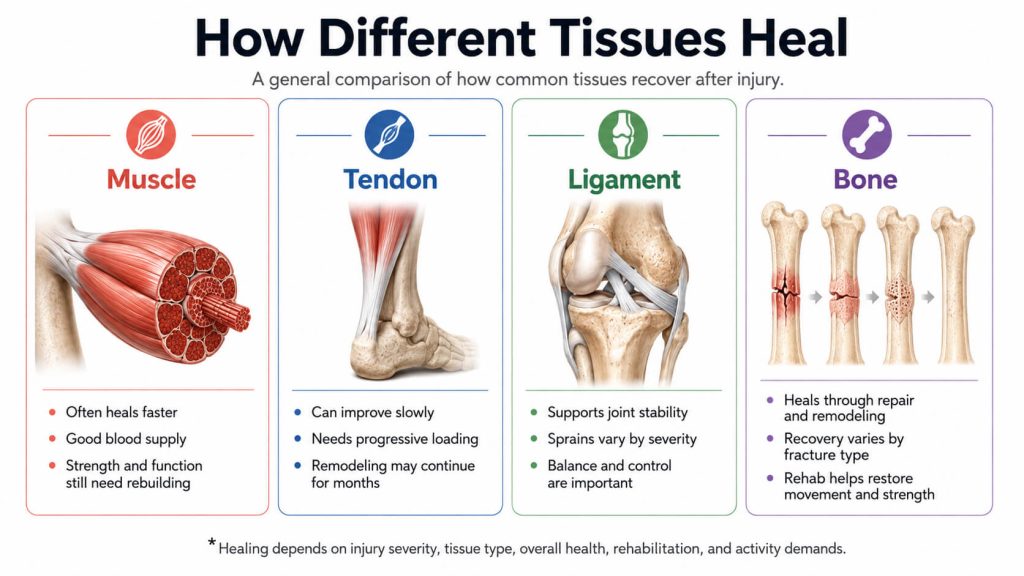
Muscle Strains
Muscle strains occur when fibres are overstretched or torn. Mild injuries can improve relatively quickly, while larger tears may require longer rehabilitation to restore strength, speed, and power.
Tendon Injuries
Tendons connect muscles to bones and often require progressive strengthening during recovery. Pain may improve before the tendon has regained enough capacity for running, jumping, or heavy repetitive activity.
Ligament Sprains
Ligaments connect bone to bone and help stabilize joints. Rehabilitation commonly focuses on restoring movement, strength, balance, joint control, and confidence before returning to higher-demand activity.
Bone Healing
Fractures heal through inflammation, repair, callus formation, and remodeling. Recovery varies depending on the bone, fracture type, treatment, age, and overall health. Rehabilitation may still be needed after the bone has healed to restore normal strength and movement.
Why Healing Varies Between People
Two people with similar injuries can experience very different recoveries. Factors that may influence the tissue healing stages include:
- Severity of the injury
- Type and location of tissue
- Age and general health
- Nutrition and sleep
- Smoking
- Rehabilitation consistency
- Physical demands of work or sport
Returning to normal walking, for example, requires far less strength and coordination than returning to competitive basketball, running, or heavy physical work.
Feeling Better Does Not Always Mean Fully Healed
Pain is only one part of recovery. An athlete recovering from an ankle injury may be able to walk normally before being ready to sprint, jump, cut, or rapidly change direction.
Before returning to demanding activity, factors such as strength, mobility, balance, endurance, power, and movement control may still need to be restored.
Feeling better is an important milestone, but it is not always the final stage of recovery.
How Chiropractic and Physiotherapy Support Healing Stages
Chiropractic and Physiotherapy can help guide recovery according to the injury, symptoms, healing stage, and individual goals.
Early Recovery
- Manage pain and excessive swelling
- Protect injured structures
- Maintain safe movement
Rebuilding Strength and Mobility
- Restore range of motion
- Progress strengthening
- Improve balance and control
Return to Activity
- Build endurance and power
- Progress running, jumping, or agility when appropriate
- Prepare for work- or sport-specific demands
Kinesiology and active rehabilitation may also help rebuild strength and movement capacity during later stages of recovery.
Signs You May Be Ready to Progress
There is no universal checklist for every injury, but important signs may include:
- Pain is minimal and manageable
- Swelling is controlled
- Functional range of motion has returned
- Strength and balance have improved
- You can tolerate progressively harder activity
- You can perform movements required for your sport, job, or daily activities
More significant injuries, fractures, surgical repairs, or persistent symptoms should be assessed individually by the appropriate healthcare professional.
Supporting Healthy Tissue Healing
There is no shortcut through the tissue healing stages, but healthy habits can support recovery.
- Follow your rehabilitation plan
- Increase activity gradually
- Prioritize sleep and recovery
- Eat a balanced, nutritious diet
- Avoid repeatedly aggravating the injury
- Rebuild strength before returning to demanding activity
The goal is not simply to recover as quickly as possible. It is to allow the tissue to heal while rebuilding the physical capacity needed for long-term function.
Understanding Your Recovery
The tissue healing stages provide a useful framework for understanding injury recovery. Inflammation begins the repair process, new tissue forms during the repair phase, and remodeling helps the tissue become stronger and more capable over time.
Successful rehabilitation considers both biological healing and functional recovery. Restoring strength, mobility, balance, and tissue capacity can help prepare the body for a safer return to normal activity.
Recover With Couve Health Chiropractic and Physiotherapy
If an injury is affecting your ability to work, exercise, play sports, or complete everyday activities, the team at Couve Health can help guide your recovery.
Our chiropractors and physiotherapists assess your injury, movement, current level of function, and goals to create a progressive rehabilitation plan based on your stage of recovery.
Visit one of our Couve Health professionals today:
- Book a chiropractor or physiotherapy appointment: Book an appointment
- Learn more about treatment: Learn More
- Call us: 604-449-7606
- Visit our website: Couve Health
Recovery is more than waiting for pain to disappear. Understanding the tissue healing stages and following a progressive rehabilitation plan can help create a safer path back to movement, work, exercise, and sport.